
I’m back home now from IMO 2024, my sixth IMO and first as team leader. But it is the students who carried the day, winning first place as a team with six excellent individual results. We had five gold medals and one silver. Jessica Wan, the first girl on our team since 2007, was the 5th place individual in the world and 1st place girl! Alexander was the 3rd place individual, beating his 6th place finish last year. This is all thanks to their parents, teachers, all our great trainers, and especially these six students who have been working hard for years to get to this point!
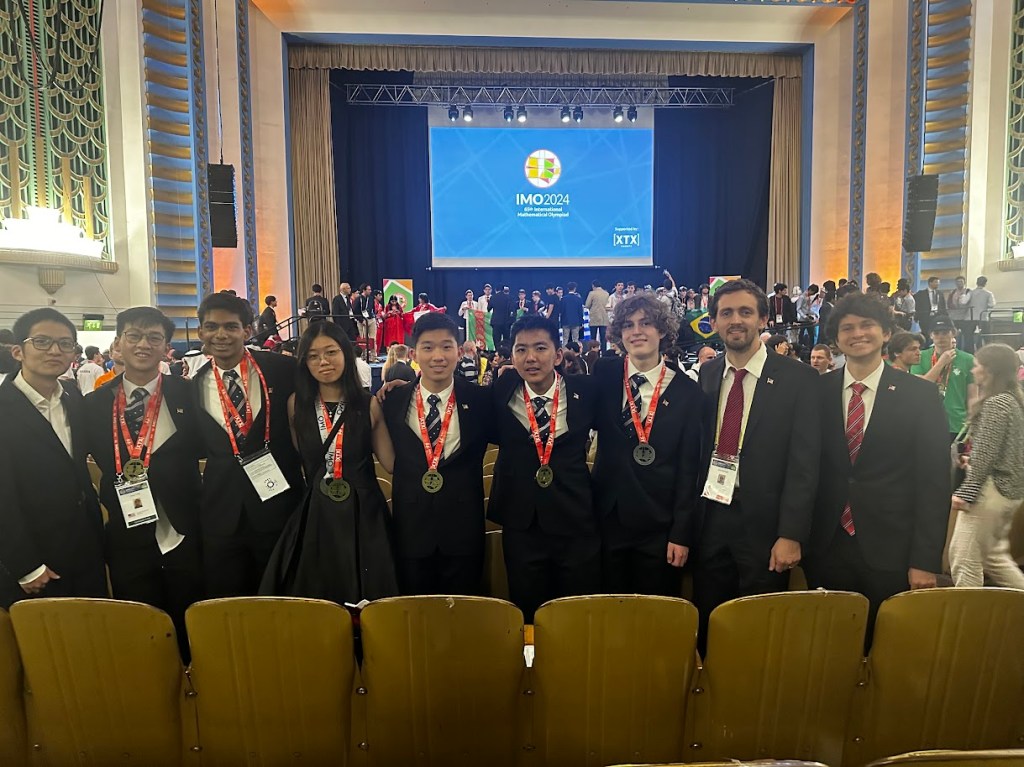
Although the fans at home root for their country’s team, the IMO is strictly an individual competition. The winning team receives no award or even official recognition. Instead, the spirit is one of collaboration and celebration. Every participant shares the remarkable distinction of being top six in their home country, and one of the highlights of the IMO is seeing these bright teenagers from around the world enjoying each other’s company.
This collegiality began three days before the students arrived, when the team leaders checked in to the Mercure Grand Hotel in Bristol. For the leaders, this is a special period – we get a chance to work together, compare notes on math education in our countries, and meet friends new and old. Most importantly, during this time we chose the 6 problems on the exam from a shortlist of more than 30, translated the exam into 57 languages, and approved the marking schemes written by the diligent team of coordinators (graders).
Once the students arrived and the test was set, we loaded into buses to travel to the student site at Bath for the opening ceremony, which was held at a historic theater in downtown Bath. The opening ceremony is always a complicated affair – the team leaders know what will be on the test, so they need to be kept completely isolated from the students. This year, we arrived at the theater well in advance of the students and were kept sequestered upstairs, where we ate lunch and mingled while we waited for the students to arrive. Once they arrived, we sat upstairs at the theater and, to the dismay of the theater staff, we leaned over the railing to try to find our students and deputy leaders. Andrew and I finally spotted ours after the ceremony was over, and we waved and wished them well.
IMO 2024 was supposed to be held in Ukraine, but due to the war it was moved on short notice back to Bath, where the IMO had been held in 2019. In honor of the original host country, the opening ceremony began with a very talented group of Ukrainian dancers. Then there was a short speech and the customary procession of countries. Afterwards, we were bused back to Bristol to continue working on marking schemes.
The next day was a slow one for the leaders, as the students took the first day of the competition. To the dismay of those who dislike number theory, this day featured three problems about integers. Problem 1, an algebra problem concerning divisibility of floor functions, is notable for having a large number of possible solutions, as problems involving floor functions sometimes do. Problem 2 is a classical number theory problem, and problem 3 is a very difficult exercise in logic.
In the evening, Andrew and I received our students’ papers and graded problems 1 and 2 right away – no issues there. Then we looked at problem 3 and got our first taste of the six papers that would consume our next three days. Every one of our students had made important progress, but none of them had completely solved the problem, and the papers were full of confusing logic and minor errors. (The 4.5 hour time limit doesn’t leave much time to write beautiful proofs!) We decided to go to bed and revisit problem 3 with clearer minds.
The second day of testing was controversial because of problem 5, which asks how many lives Turbo the snail needs to get across a board while avoiding monsters. Many of the top countries in the world couldn’t navigating Turbo’s minefield, and afterwards many students were upset that the answer was much easier than expected. As I see it, this is just like life – we so often make our problems unnecessarily complicated. The best problem solvers have a fifth sense; they can tell whether to keep things simple or start pushing through technical details.
Once the second day of testing began, there was no longer any need to separate the students and team leaders, so the leaders checked out of our hotel in Bristol and were bused to the student site at the University of Bath. The arrival at the dorms was a transition from order to chaos. Abandoning the usual British love of queues, we mobbed the check-in desk to fight over room keys, each of us responsible for finding our own key in a giant pile, then we wandered confused around the dorms trying to find our rooms. Many keys, including mine, did not actually work, so I went back to the check-in desk with all my luggage to have the key reprogrammed.
Then I went to one of the two dining halls to have lunch. Failing to find my team, I headed to the other dining hall, back to the first, and finally ran into the rest of my team there. It turned out that they had done well with Turbo the snail, with five complete solutions. They had also heard that China, the usual winner of the IMO, had only had three solutions.
The food at the student site was quite a shock after the good meals in Bristol. I didn’t like the dining hall much at all, but the team and Carl (the deputy leader) were sick of it – in two cases sick with possible food poisoning. So we decided to cut our losses and go into the city for dinner. This was my first encounter with Bath. The bus ride downtown from campus is truly beautiful; the whole city is a kind of homage to Ancient Roman architecture, even the houses that rise along the hills above downtown. We had a lovely Thai dinner and were impressed by the Roman baths and Bath Abbey.
For the next two days, the students enjoyed excursions to Oxford and Stonehenge while Carl, Andrew, and I were hard at work trying to understand their papers. Grading at the IMO is a collaborative effort between team leaders and coordinators. The coordinators grade all the papers, and each country’s delegation grades their own students’ papers, and then they compare notes. This ensures that the final scores are as accurate as possible – the coordinators ensure that the process is fair and impartial and that students from different countries with the same ideas receive the same score. The team leaders ensure that the coordinators haven’t missed anything and (though this is not relevant for our team) can understand what their students have written in Farsi or Mongolian or Vietnamese.
There are times when we think the coordinators’ scores are too low. Sometimes we can talk them up, and sometimes we can’t. But there are also times when the coordinators missed a mistake in the student’s work, and then it is our duty to bring the score down in keeping with the rubric. All of these outcomes happened this year.
Problems 1 and 2 were finished quickly on the first day of coordination; our students lost just one point between the two problems. And problems 4 and 5 were easily coordinated on the second day. The real challenge was problem 3, which ate up most of our free time over these two and a half days, as we struggled to understand what our students had done and whether their work could be completed. We ended up meeting with the problem 3 coordinators three times, going carefully over every paper with them, and achieving a score distribution of 0,2,3,3,5,6, unusual for such a hard problem.
Problem 6 was also very difficult, but our papers were easier to read. We had one remarkable paper which contained all the elements of a complete proof in the scratch paper, but the student had not connected the dots and realized that he could solve the problem with what he already knew. Our greatest disappointment in coordination was that this paper received only a 3.
Nonetheless, we felt very good about our work when coordination was complete and we could finally relax. We went (prematurely) for a celebratory dinner in Bath. When we returned, we ran into the Chinese delegation and compared notes. We knew our scores would be close but expected China to eke out a narrow victory. Instead, we learned that we had won by two points! With such a narrow victory, every one of our students’ papers and all of our hard work in coordination had turned out to be essential! But both teams were good-natured about the outcome, and the American and Chinese teams could be seen playing cards together in the XTX Hub (game room) on multiple occasions after the results were announced.
The next morning at the final jury meeting, the results were made official. The US had won for the first time since 2019! During our winning streak in the 2010s, there was a tradition of eating at McDonald’s when we won. After some deliberation, the students decided to revisit this practice, so after eating a proper dinner, we headed back to Bath, and those who could stomach McDonald’s did so. Kudos to our high scorer Alexander Wang, who successfully ate 38 chicken mcnuggets in honor of his score of 38 points.
In this post-competition period, there were lots of featured talks – by fields medalists (Terry Tao), youtube stars (Grant Sanderson of 3Blue1Brown), and others. A common topic of conversation at this year’s IMO was AI, and in particular XTX Market’s $10 million prize to the designers of the first AI to win a gold medal at the IMO. After the IMO ended, we learned that Google’s AlphaProof and AlphaGeometry had solved four out of six problems, coming one point shy of a gold medal, but with caveats – the program required human assistance in translating the problems into formal language it could understand, and it took far more than the 9 hours allotted to contestants. The prize hasn’t been won yet!
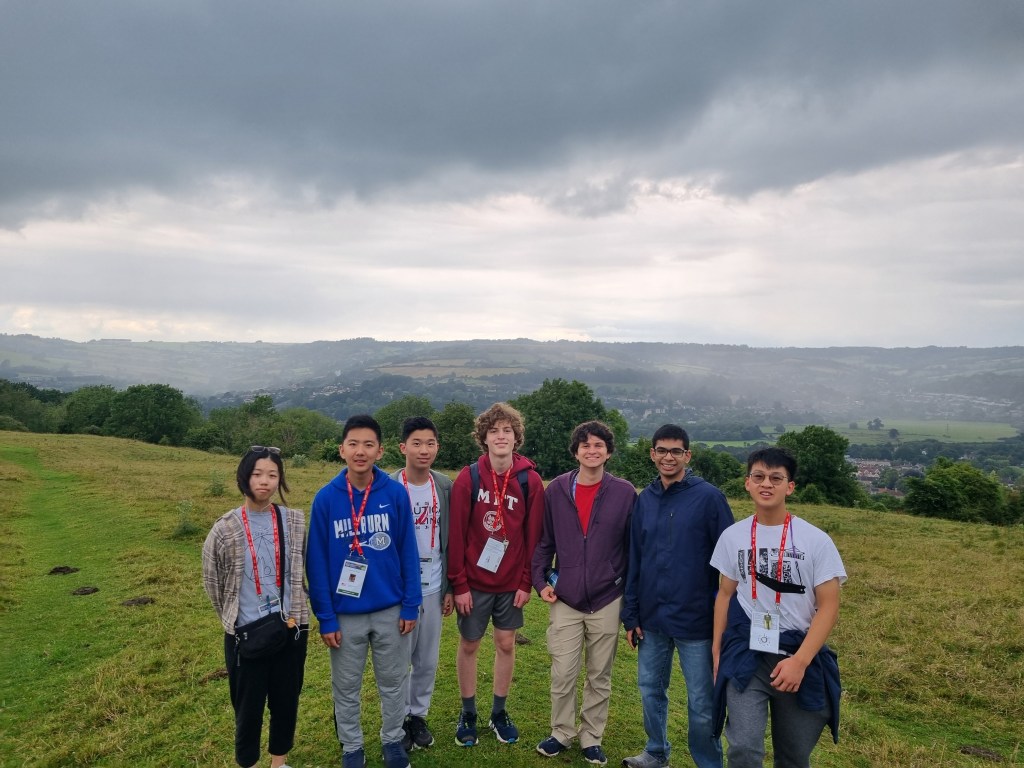
On the final day of the IMO, we took a walk on the beautiful Bath skyline trail through cow pastures and tiny canopied roads, and then we loaded onto buses for the closing ceremony, where we reconnected with some old friends. For the second year, IMO alumni were invited to the closing ceremony for the IMO reunion, and two of our alumni came this year – Ryan Alweiss and Tony Zhang. Our previous team leader Po-Shen Loh was also present as the organizer of the IMO alumni reunion, and a whole host of Americans came as coordinators – former team leader Zuming Feng, former deputy leader Razvan Gelca, and familiar faces Michael Ren and Evan Chen. Last year’s US team member Eric Shen was there as leader for Ghana. Altogether, there was no shortage of Americans this year in attendance.
At the closing ceremony, there are no team awards, but all six of our students received their medals and Jessica Wan received an additional medal (the Maryam Mirzakhani prize) as the top scoring girl in North America. She was also the top scoring girl overall, but there is no medal for that! Then we took photos and headed back to campus for the final party.

Final parties are some of the most memorable parts of each IMO, and this year’s was no exception. A field at the university had been set up as a fairground, complete with theme park rides, food trucks, a classic rock band, dance floor, and bar. The party culminated with fireworks. Another IMO to remember!
 GeodeMath