
This is my second note on Ancient Greek mathematics, following last year’s post on planar numbers. At the time, I had just read Introduction to Arithmetic by Nicomachus, written around 100 AD. I hoped to learn a little about the history of math, but I didn’t expect to learn any actual mathematics. However, I am always amazed at how much math is out there! I was surprised to learn about a whole theory of mean progressions that has been largely forgotten (at least to my knowledge).
The familiar means
The Pythagoreans (the Ancient Greek mystics who used math and music theory to worship the gods) were interested in sequences 


For example, if 


On the other hand, if 

The Greeks were interested in infinite geometric sequences like 

Third, if 


Problem 1. Prove that a sequence 
Problem 2. Can you find a harmonic sequence of 5 integers? 6 integers? What about a harmonic sequence of 
The forgotten means
Remember: We are interested in progressions 


implies
implies
, the harmonic mean.
implies
, the contra-harmonic mean.
implies
, the first contra-arithmetic mean.
implies
, the second contra-arithmetic mean.
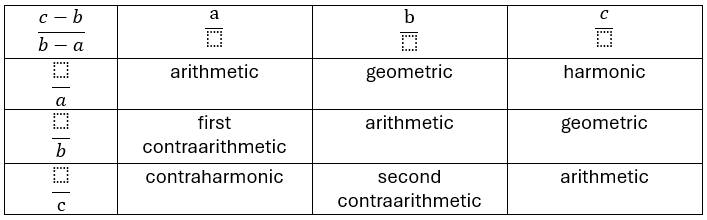
The contra-harmonic mean is so-called because it is the reflection of the harmonic mean across the arithmetic mean. In other words, the average of the harmonic mean and the contra-harmonic mean is 
Problem 3. Does there exist a contra-harmonic sequence of four integers?
I think this may be an open problem, so let me know if you solve it! For example, 

Problem 4. If 

Visualizing means
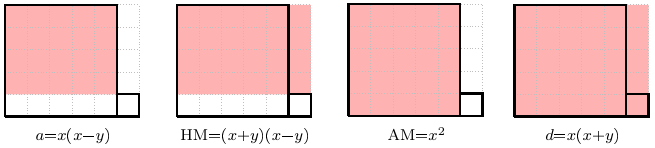
Shown above are an 


The Pythagoreans considered this sequence to be especially beautiful because it connects planar numbers (in this case, rectangular) with the three most important types of mean progression: 


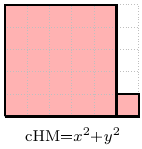
In fact, the contra-harmonic mean of
Not nice enough to be mean
Arithmetic, geometric, and harmonic sequences all have a nice property that I call the subsequence property2: If 


Problem 5. Prove that arithmetic sequences, geometric sequences, and harmonic sequences each have the subsequence property.
The subsequence property has desirable consequences: For example, it implies that there is a simple formula for the 


Problem 6. Prove that contra-harmonic, first contra-arithmetic, and second contra-arithmetic sequences do not have the subsequence property.
Perhaps this is one reason that these exotic means have been forgotten. As a result, it is not easy to calculate the
Problem 7. If 


Problem 8. The Heronian mean 
A hard functional equation
We have already started to move beyond Ancient Greek ideas, but here is a question in a very modern style: Can we describe all possible means? We should start by listing some properties that means should have:
- A mean should be a function
defined on positive real numbers
- It should satisfy
and
.
- It should satisfy the subsequence property: If
is a sequence of positive real numbers satisfying
for all integers
, then we should also have
for all integers
.
Problem 9. Find all functions means satisfying these three properties.
Problems 3 and 9 are very difficult. Let me know if you can solve them!
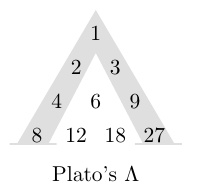
- Plato’s Lambda is a visual demonstration of the Fundamental Theorem of Arithmetic, that every positive integer has a prime factorization. By starting with the prime powers and filling in the spaces between them using geometric sequences, all positive integers appear. Only the powers of 2 and 3 are shown in the visual. For Plato, this process symbolizes the creation of the world through geometric progression, but it also reflects how modern mathematicians think about number theory, as a progression from primes to prime powers to all natural numbers. ↩︎
- Modern mathematicians don’t usually think about means in terms of ratios like
is an increasing function defined on positive real numbers, then
can be thought of as a mean. The arithmetic mean corresponds to
, the harmonic mean to
, and the geometric mean to
. For more, see generalized means. ↩︎
 GeodeMath